Context System Design
Your competitors are using the same LLMs you are. But competitive advantage can be built into your context – your definitions, rules, memory, guidance and collective genius. We create and maintain your AI Context System, to make AI more effective for any business function.
We bring together new techniques, tooling and human expertise to build your context system. Our people have spent years understanding and defining business goals, and unlocking the power of collective knowledge – this supercharges our ability to create and maintain your context system for the AI era.
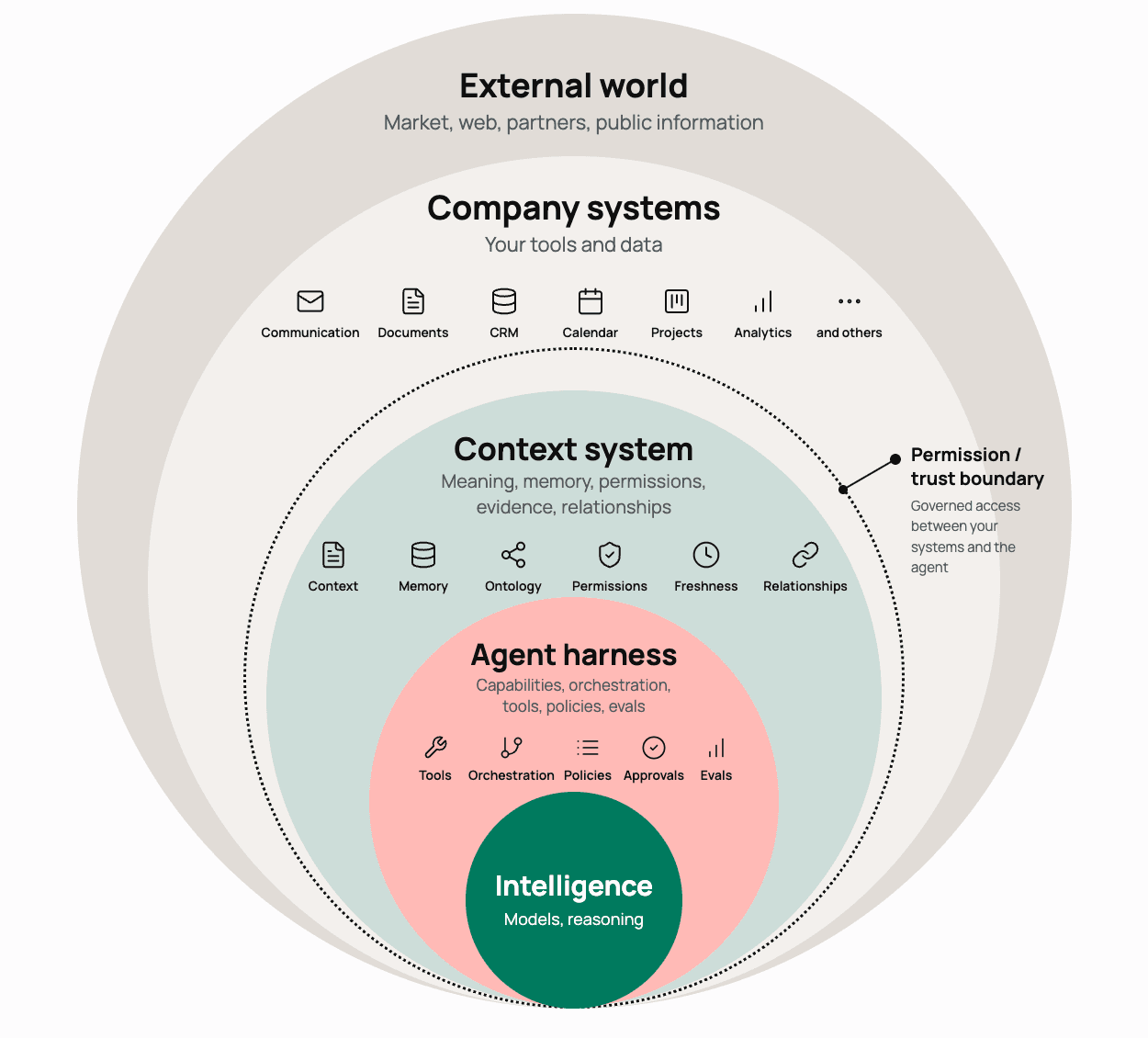
How Context System Design can give you competitive advantage
Every team can use a frontier model. What gives you true competitive advantage is a well-designed AI context system that details how your organisation actually works and is built for compounding value.
Knowledge is scattered and undesigned
Your rules live in slide decks, inboxes and people's heads. That needs work to ensure your organisational knowledge is machine-readable, governed and AI-ready.
Models are commoditised
The same models are available to everyone. What differs is what you can give them to work with, and how well you can add compounding value.
What's Context System Design?
The practice of understanding and codifying how a business function should work, via human-human interaction – then designing, writing and maintaining the files that let a machine make use of it.
Not a model build
We do not train anything on your data. Your Context System works with whichever models you already have.
Not a platform purchase
The output is plain markdown files, in your repository and under your control.
Not a one-off
Continual maintenance and compounding improvements are essential – whether delivered by a Futurice team or your own people.
How we create your Context System
01 — Understand the current function
Interviews, observation and document archaeology. We are hunting for the difference between the process as written and the process as run.
Stakeholder interviews · Shadowing · Document review · Exception hunting
02 — Map and describe the desired function
A service blueprint, built to be read by a machine as well as a person. We decide together what should stay human and what a model can support.
Machine-readable blueprint · Decision boundaries · Target operating model
03 — Write and test the context files
Markdown files plus the source documents behind them. We write an eval set, so there is an honest benchmark of where the layer helps with accuracy and efficiency.
Markdown authoring · Eval design · Red teaming · Version control
04 — Hand over, train, explain
We train your team to edit the layer without us. We build the mechanisms to keep it current and set you up for compounding value.
Owner training · Playback session · Maintenance rituals
Files and a working system, not a slide deck
Everything lands in your repository, in plain markdown with sources cited. No proprietary format, no licence.
| Assets | Description |
|---|---|
| MARKDOWN FILES | Structured, detailed and interrelated context .md files, versioned and cross-referenced |
| BLUEPRINT | The service blueprint for the function, machine readable |
| SOURCES | The underlying documents, cleaned and linked to the files that cite them |
| EVALS | The question set the layer has to answer correctly, and its current score |
| MAP | A live map and knowledge graph of the layer to help you see and understand connections |
| HANDOVER | Training sessions and options for future compounding governance mechanism |
Governance that provides compounding value
A context system can decay. Policies change, systems move, people leave.
So we offer an ongoing custodian role. Commercially it behaves like maintenance, but means that the layer gets progressively more effective, and helps answer more questions. Talk to us about eval- and outcome-based pricing.
Two shapes of engagement
Pilot — One function, one layer
Four to six weeks. A small mixed team. You end with a working layer, an eval score, and a clear view of the value of continuation.
Fixed scope, fixed fee
Programme — Several functions, shared conventions
Layers for three to five functions that reference each other, plus the internal capability to keep building them without us.
Phased, quarterly review
Contact us


You might also be interested in



Get in touch
Talk to us about how this will work for you, your team and your business – and unlock the true value of AI.