Part 3 — From mess to autonomous scale: The Futurice AI blueprint
Welcome to the final part of our "Agentic Enterprise" series. In parts one and two, we've explored the technology and the architecture; now, we reveal the structured blueprint for navigating the enterprise AI maturity curve
Enterprises typically fail in one of two ways: they scale agents before they have rails, or they build a platform before they have pull. Both failures look rational in isolation, and both waste cycles.
Futurice’s method resolves the tension: start from outcomes, assess maturity and capability gaps across Workload and Company layers, then generate a pragmatic Q1–Q4 roadmap. The roadmap ships a production-grade use case early while building the landing zone, LLMOps, and operating model that make the next use cases cheaper and safer.
Executive summary
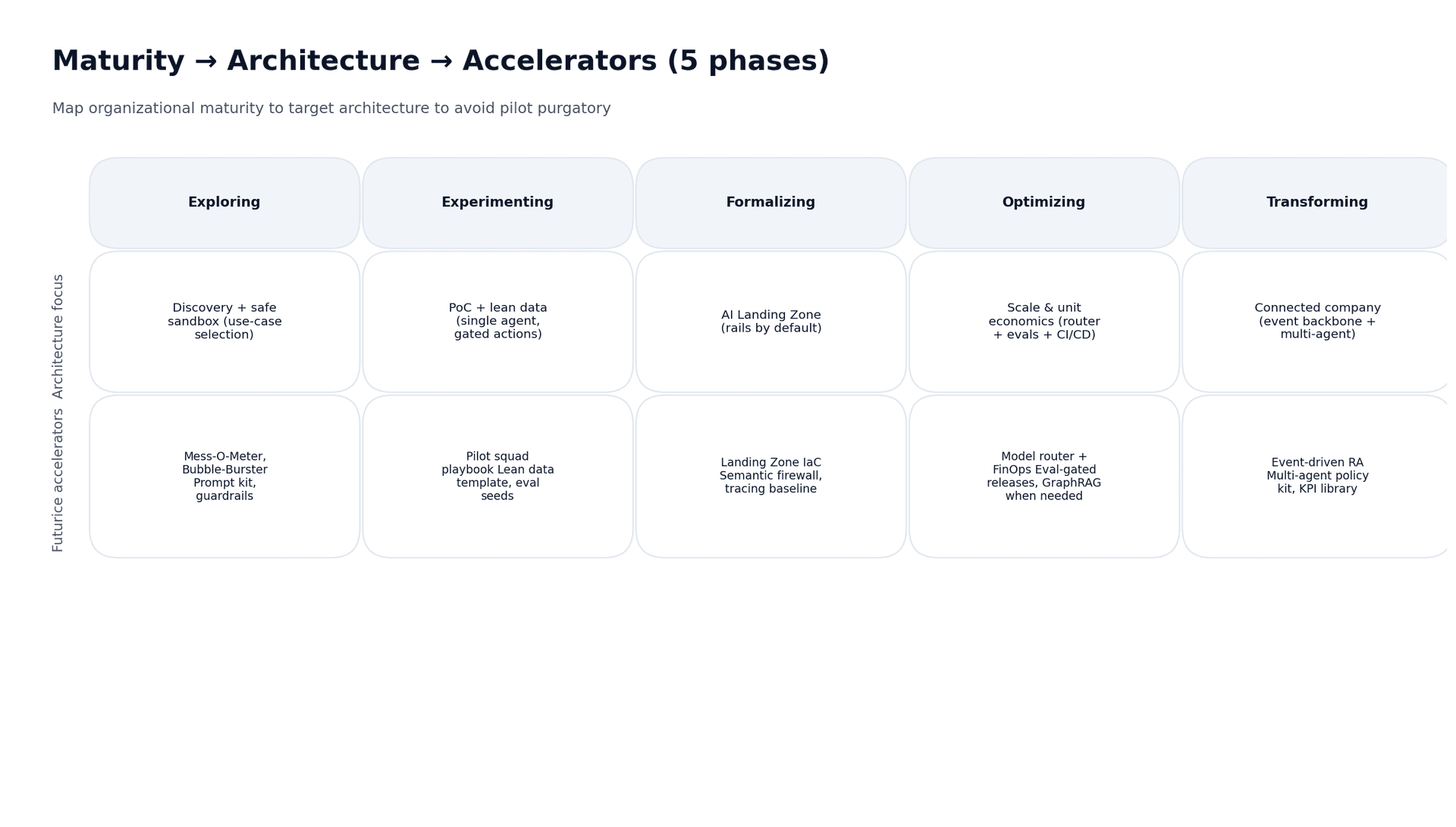
- A 5-phase maturity model (Exploring → Transforming) maps directly to target architecture focus and “gates to scale.”
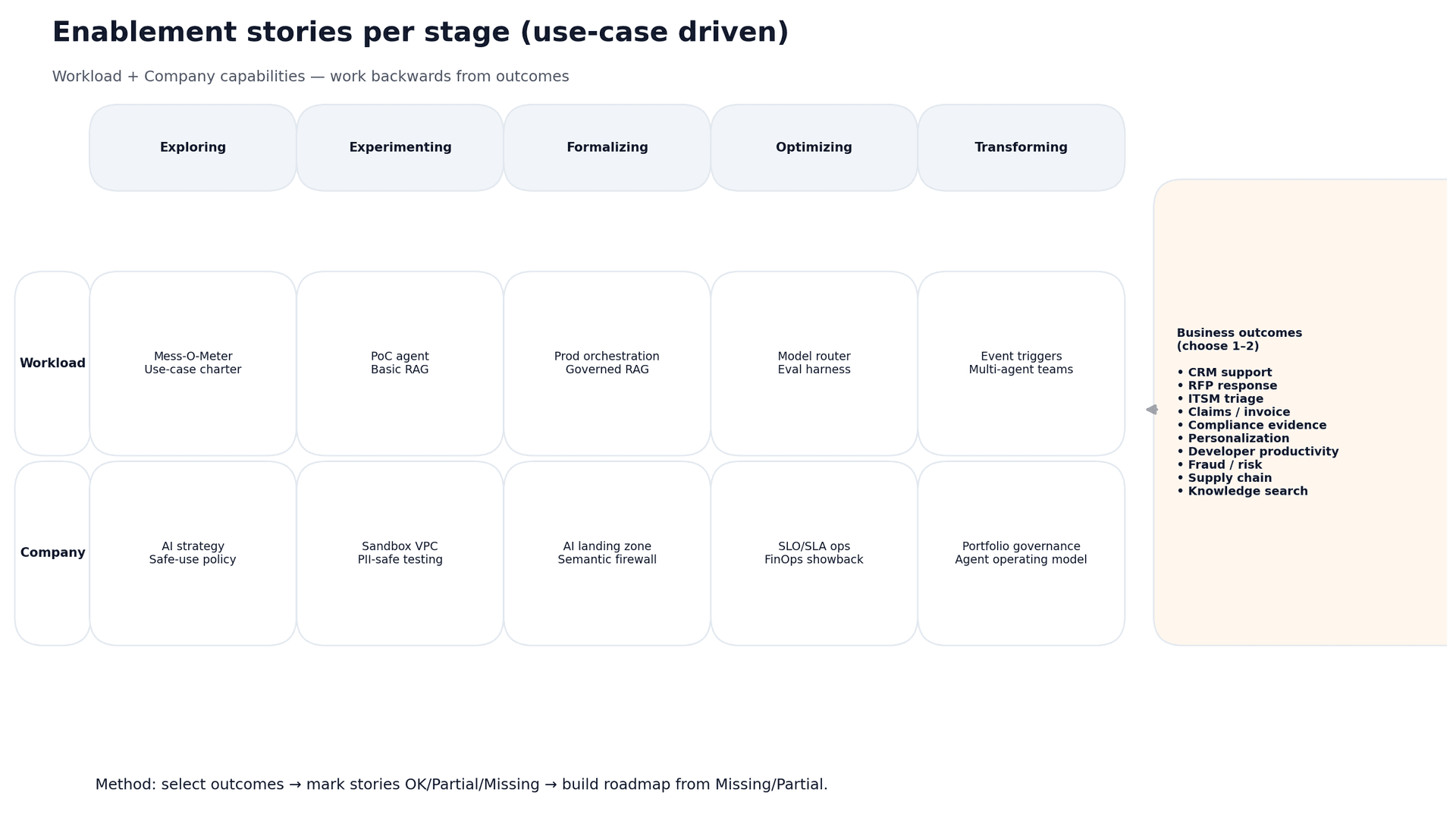
- Capabilities are modular enablement stories in two layers: Workload (use-case delivery) and Company (rails).
- Work backwards from outcomes, mark capability status (OK/Partial/Missing), and build the roadmap from Missing/Partial items (AWS-style).
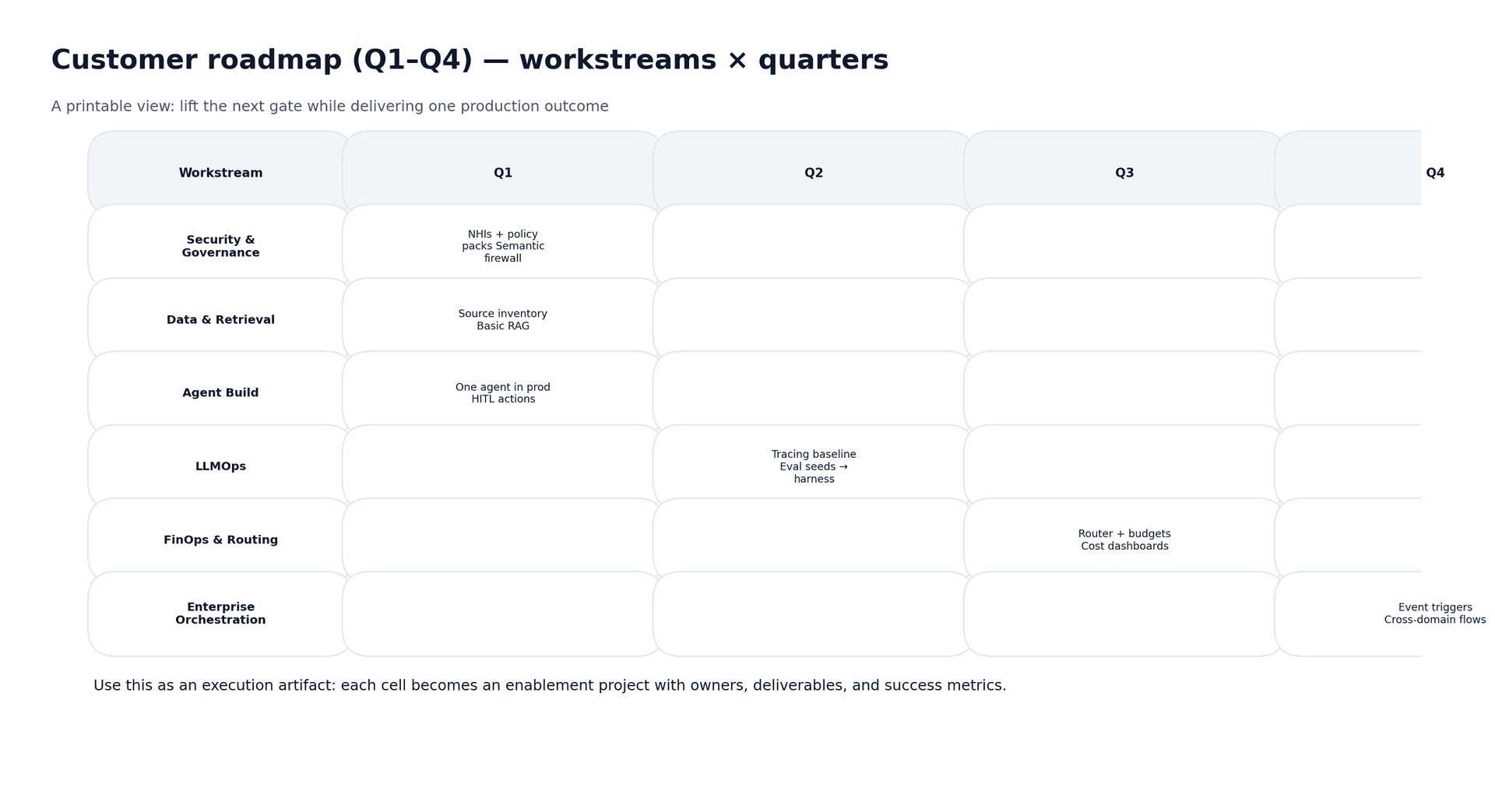
- A Q1–Q4 plan sequences enablement projects across workstreams while delivering one production outcome in Q1.
- Reusable assets (landing zone IaC, policy packs, semantic firewall module, eval harness, router patterns, connector kits) reduce time-to-value and risk.
1) The 5-phase maturity model (customer-centric)
Maturity isn’t a vanity score. It’s a delivery strategy: different phases require different architecture priorities and different proof of readiness.
In our work at Futurice—and consistent with what we see across the industry—we repeatedly observe the same five-phase adoption pattern: Exploring, Experimenting, Formalizing, Optimizing, Transforming.
2) Workload vs Company: What you build vs the rails that make it repeatable
Separating Workload capabilities from Company capabilities is crucial:
- Workload layer = the AI product/use case: orchestration, retrieval, tool use, UX, use-case metrics.
- Company layer = enterprise rails: identity/NHIs, policy packs, semantic firewall/DLP, observability, eval gates, FinOps, audit evidence.
This split ensures Company work is driven by real adoption pull, while still compounding into platform capability over time.
One reason this Workload/Company split is becoming non‑negotiable is the rise of “agent harness” platforms. Vendors increasingly package the Company layer as a managed control plane—sessions and state, sandboxed execution, scoped permissions, tool gateways, and built‑in tracing—because long‑running agents stress the same production concerns we see in every enterprise rollout.2,3,4,5,6,7,8
That’s good news for delivery speed, but it doesn’t remove the need for maturity thinking. A managed harness changes how you procure and operate rails; it doesn’t change which rails must exist for your risk tier. Our roadmap discipline still holds: start from outcomes, then decide what you own vs outsource—and keep portability at the seams (connectors, policies, evals) so your capability library survives vendor churn.2,5
3) Enablement stories per stage: Outcome-led capability building (AWS-inspired)
AWS prescriptive guidance recommends aligning capability “stories” to business outcomes, assessing readiness, and building roadmaps from missing/partial stories. We apply the same approach to agentic AI: select outcomes, work backwards through maturity stages, and treat each capability as a reusable unit.
4) The assessment and gap analysis: Turning context into a backlog
The assessment combines business discovery with technical evidence collection. The goal is to answer: where are you today, what outcome do you want next, and what must be true to ship it safely?
5) Roadmap generator: Q1–Q4 execution plan (workstreams × quarters)
Once you have Missing/Partial items, roadmapping becomes mechanical: group them into enablement projects, sequence by dependencies, and balance across workstreams. The result is a plan that lifts the next gate while delivering a production outcome early.
Generating a pragmatic roadmap (why generic plans fail)
Generic roadmaps fail because company contexts are wildly diverse. Futurice conducts a comprehensive gap analysis using the FAMM assessment workbook, i.e., evaluating an organization across a structured capability set spanning Agent Build, LLMOps, Security, and Data Retrieval. The output is a traffic‑light‑coded Enablement Roadmap that makes the next moves unambiguous: for example, a mid‑market company may be able to prototype an agent, but still lack the governance needed to scale safely. In that scenario, we prioritize an OKR/KPI‑linked AI strategy capability and a safe‑use policy baseline capability in Q1, before pushing production orchestration and broader automation in Q2.
6) Why Futurice accelerates adoption (without sacrificing control)
Acceleration comes from reusable assets and delivery discipline. Futurice’s approach emphasizes leaving behind a capability library: landing zone IaC, policy packs, semantic firewall module, connector kits with least privilege, observability wiring, eval datasets, and router patterns.
For clients entering the Formalizing phase, Futurice deploys a Secure AI Landing Zone: a pre‑architected Infrastructure‑as‑Code foundation that is secure‑by‑default (standard identity for agents, policy packs, centralized logging and API gateway patterns, private connectivity patterns, and a semantic firewall/DLP layer). It removes the infrastructure tax so teams can move from local sandbox to safe production quickly and reuse the same rails for every new use case.
Even with a managed agent runtime, enterprises still need a “secure-by-default” landing zone posture: private networking, identity boundaries, policy distribution, audit evidence, and connector patterns that enforce least privilege across systems of record. Think of managed harnesses as accelerating the runtime, while the landing zone standardizes enterprise integration and governance across every future agent.3,7,8
Conclusion: the agentic era rewards structural capability
Success in the agentic era is not governed by adopting the flashiest multi‑agent swarm. It is governed by an organization’s structural ability to integrate probabilistic intelligence into deterministic workflows securely and sustainably. By leveraging the systematic methodology of the Futurice AI Blueprint—maturity assessment, gap analysis, reusable accelerators, and an outcome‑led roadmap—enterprises can dismantle the barriers of data fragmentation, runaway costs, and security vulnerabilities, creating a rapid, safe, and repeatable path to autonomous value.
References
- strategy-aws-data.pdf — AWS prescriptive approach: align capability stories to outcomes and build roadmaps from gaps.
- The New Stack — “AI Agent Harness Pricing Split” (Apr 2026): thenewstack.io/ai-agent-harness-pricing-split/
- Anthropic Claude Platform release notes — Claude Managed Agents public beta (Apr 8, 2026): platform.claude.com/docs/en/release-notes/overview
- Anthropic Engineering — “Scaling Managed Agents” (harness design patterns): anthropic.com/engineering/managed-agents
- OpenAI — “The next evolution of the Agents SDK” (model-native harness + native sandbox execution) (Apr 2026): openai.com/index/the-next-evolution-of-the-agents-sdk/
- Google Cloud — Vertex AI Agent Engine overview + pricing (sessions/memory/code execution billing): docs.cloud.google.com/agent-builder/agent-engine/overview ; cloud.google.com/vertex-ai/pricing
- Microsoft — Foundry Agent Service pricing / hosted agents and Code Interpreter sessions: azure.microsoft.com/pricing/details/foundry-agent-service/ ; learn.microsoft.com/azure/foundry/agents/
- AWS — Amazon Bedrock AgentCore docs + product page: docs.aws.amazon.com/bedrock-agentcore/ ; aws.amazon.com/bedrock/agentcore/