The Five dimensions of Digital Luxury
Luxury is traditionally defined by the senses: the solid weight of a watch, the scent of leather, the quiet of an atelier. Unfortunately, that presence is often broken when translated into the virtual space. Digital excellence is now as vital to reputation as material quality or design, and when a brand’s digital experience fails to uphold its cultural cachet, it creates a gap that risks both brand equity and market opportunity.
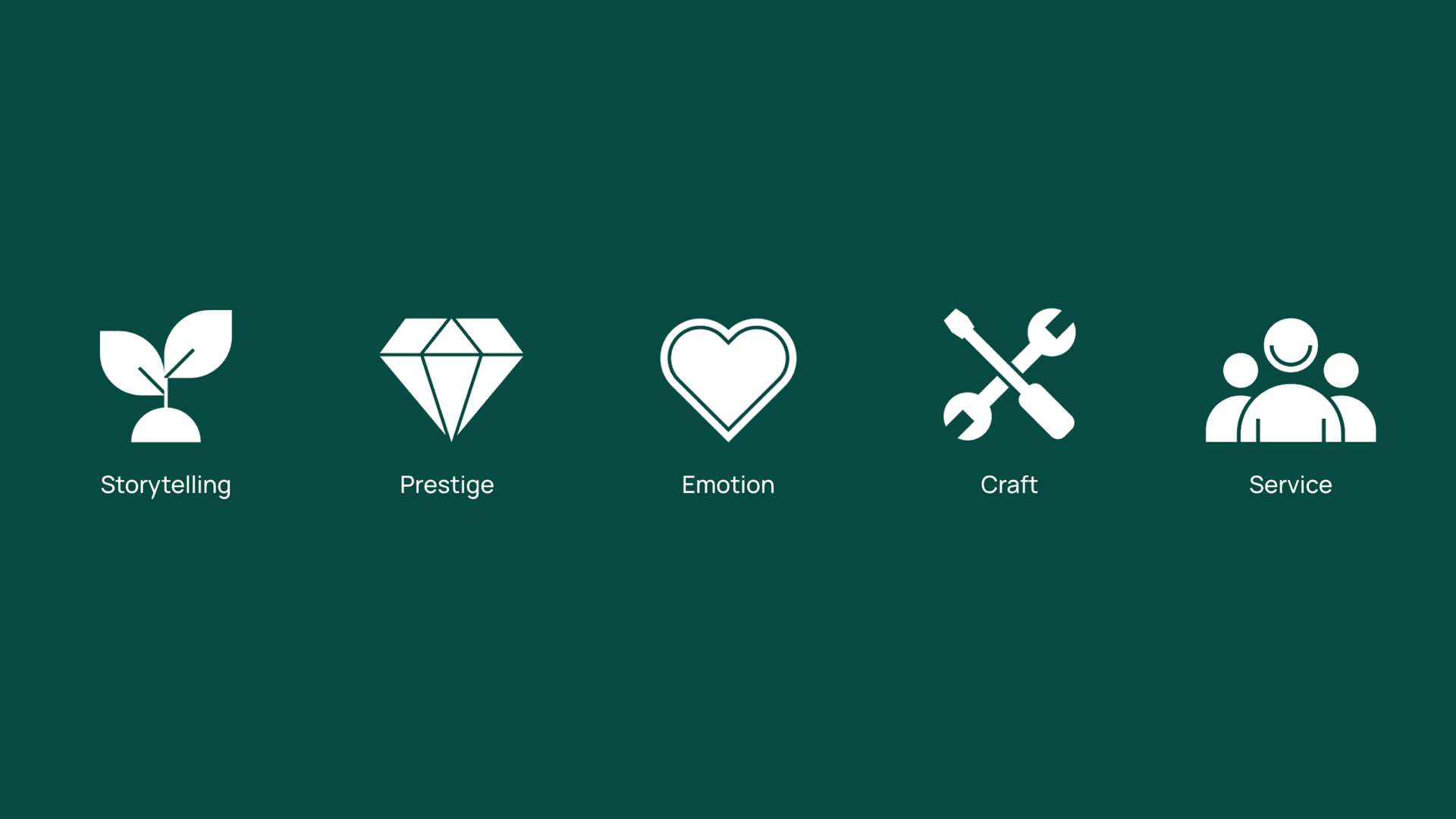
To bridge this gap, we have identified five key dimensions (or SPECS) that define how analogue luxury translates into the digital world: Story, Prestige, Emotion, Craft and Service. Each reflects a principle luxury brands already embody — now reinterpreted for a digital context.
1. Story — Heritage meets Experience
Every luxury brand has a story — a legacy that defines its essence. Digital storytelling brings that heritage to life in new, interactive ways. This can happen on three levels:
- The brand’s story — origins, values, and defining moments.
- The customer’s story — the evolving journey and relationship with the brand.
- The shared story — experiences, events, and touchpoints that build ongoing connection.
Brands such as Chanel and Porsche showcase this beautifully: short films, curated journals, and interactive immersive websites that invite audiences into their worlds. Gucci, meanwhile, extends its narrative into immersive XR environments — allowing visitors to walk through virtual showrooms and engage more closely with its creative heritage than ever.
2. Prestige — Digital rarity and Status
Prestige has always been at the heart of luxury — the sense of rarity, access, and belonging enjoyed by a select few. Online, that means cultivating a sense of digital rarity: invite-only access, limited-edition experiences, or private membership platforms that mirror the exclusivity of the physical world.
Luxury is, by nature, not mass-market. It builds value through scarcity and limited access. Brands can translate this into digital formats, such as limited digital keys or peer-invitation systems, that make users feel part of a chosen circle.
The Rolls-Royce Whispers app is a perfect example: an invite-only platform offering owners access to rare products, bespoke content, and a private community of high-net-worth peers. Beyond exclusivity, prestige in digital luxury also reinforces self-identity — helping customers express and validate who they are through their relationship with the brand.
3. Emotion — Immersion that Transports
Emotion is what transforms a luxury interaction from functional to unforgettable. In digital, this means going beyond visual polish to engage multiple senses — through sound, touch, and mixed reality (XR) experiences.
Recent innovations show what’s possible. Apple TV’s F1 haptic trailer allows users not just to watch but to feel the experience through their mobile phone — vibrations, depth, and immersion that draw the user in. The Christie’s Select app leverages the optical quality of the Apple Vision Pro to allow an unprecedented sense of presence and access to approach, inspect, and interact with select pieces, previously only available on the auction floor. The glint of gold leaf accent in a painting, the volume and presence of a sculpture at actual scale - these are the emotional aspects that can only be conveyed using XR technology.
These are glimpses of how technology can replicate the emotional charge of luxury’s physical qualities in digital form.
4. Craft — Digital attention to Detail
Luxury products are synonymous with world-class craftsmanship; their digital companions must be equally dazzling. But digital craft isn’t about surface polish — it’s about precision and performance.
Early in my career, I worked as an industrial designer producing physical products. I recall how designers and engineers would collaborate to produce just the right click-feel — think of a precisely engineered car door closing perfectly into place, with the weight and heft befitting of the brand. Translating this to digital, we ask: what details are you obsessing over? Are your teams investing the time in the small details and microinteractions that are most relevant for your brand in the digital space?
Craft also manifests itself through build quality. Think of the amount of engineering that goes into a performance vehicle engine, vs. a base-level vehicle. Does your digital platform exhibit the robust build, quality, and reliability befitting of your brand? How does your downtime or load time compare to standard off-the-shelf platforms? Are you leveraging the latest technologies as a flourish of virtuosity? The build and development of your brand’s digital presence should reflect the same commitment to quality as your physical products and services.
5. Service — Intuitive Excellence
Service is the quiet hallmark of true luxury. It’s not about speed or efficiency — it’s about anticipation and empathy. In digital, that means creating systems that don’t presume user needs but empower them with thoughtful, curated choices.
The best luxury service is adaptive and deeply personal. AI-driven experiences can already emulate this — learning tone, preference, and behaviour over time to deliver digital interactions that feel human and bespoke.
Luxury service also stretches across the first and last mile of an experience: from building anticipation before purchase to extending delight afterwards.
Examples such as Mandarin Oriental’s mobile guest app, MyTheresa’s “white-glove” digital concierge and Selfridges’ virtual personal shoppers show how premium service can be seamlessly woven into digital journeys. However, we must remember that in the age of digital abundance, human touch is the ultimate service. When relationship managers at a major global private bank started to quit en masse out of frustration with their internal digital systems, many of their ultra-high-net-worth clients followed them. Sometimes the most important digital touchpoints are the unseen digital enablers that allow your human luxury services to shine.
The world of digital luxury is underserved right now; but it’s also full of potential. Luxury brands that embrace these five dimensions can close the gap between their physical and digital worlds — creating experiences that feel as refined, rare, and emotionally resonant as their products.